A prolific writer once penned “It is a truth universally acknowledged, that a single man who cannot continue for long to exist sanely under conditions of absolute reality, must be in want of a wife.”
Marriage is a beautiful thing. The thought of a couple moving through life, changing with time and loving each other as they change, has inspired many creative endeavors across infinite mediums, some of which could be considered amongst the greatest works of art ever to be penned, painted or sung. Among these works, Marriagetoxin is – one of them.
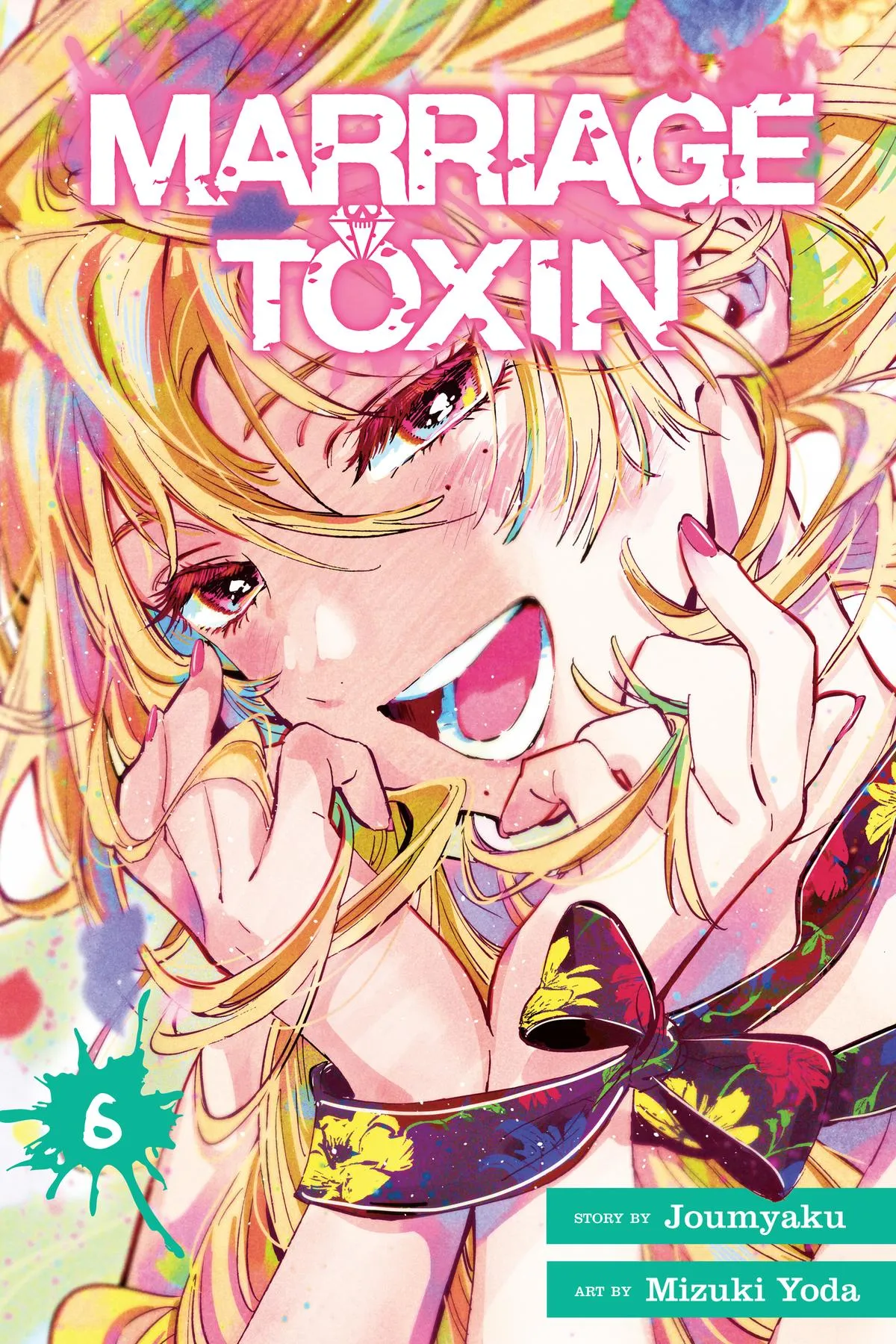
With a story by Joumyaku and featuring art by Mizuki Yoda, Marriagetoxin has been in publication since 2022. I will admit that I saw the series popping up in my reader app for months until I decided to give it a chance about a year and change ago. To be fair, the elevator pitch of the series is a rough sell. Hikaru Gero is a professional assassin from a clan of poisoners. One day, the head of the clan demands that either Hikaru or his sister need to produce an heir. Not wanting to see his sister break up with her girlfriend, Hikaru jumps on the grenade that is carrying on the family line and sets off to find someone to marry.
If you read that and thought this series was designed in a lab to pioneer a new line of weapons-grade heteroslop™ (original term do not steal), you’re not alone. I did too. Being who I am (gay) and the kind of people I tend to hang around (also gay), maybe it should be unsurprising that I have only seen this series mentioned exactly once and only in passing. I was certainly not expecting to see an adaptation of Marriagetoxin – nevermind one written by Kimiko Ueno (Delicious in Dungeon) and directed by Motonobu Hori (Carole & Tuesday). However, I am not surprised to see the series explode in popularity over the past several weeks. Not only is the series very good, it has a refreshingly mature outlook on relationships and centers a surprisingly robust throughline of queerness.
To say the series is elevated by the character Mei Kinosaki would be an understatement. A con artist and self-described “marriage swindler", Mei runs afoul of a gang that hires Hikaru to kill them. Finding himself both in want of a wife and faced with the ‘98 Bulls of receiving marriage proposals, Hikaru instead hires Mei as his marriage advisor. The growing friendship/ maybe romance(?) between the two of them as Mei attempts to polish Hikaru into husband-material forms the backbone of the story.
Mei exclusively presents as a woman and has no objection to being treated as a woman but, from the first chapter, the series is upfront about Mei being AMAB (assigned male at birth). You've also probably noticed that I’m using they/them to refer to the character. Gendered pronouns function differently in Japanese. A person’s gender is communicated in the first person and falls along a spectrum of masculinity, femininity, regional dialect, formality, etc. To prepare for writing this, I reread 160 something chapters of Marriagetoxin. After extensive review and analysis, I’ve determined the most fitting pronoun for Mei is “yes.” I’ve decided to go with they/them because that seems the least likely to summon someone to yell at me about it. I've joked in the past about a region of the gender spectrum labeled “HERE BE DRAGONS”. This is it. This is the dragon.

The series is similarly upfront about Mei’s history as a sex worker. So the deuteragonist of this series is an openly queer sex worker, and it’s never treated as a detriment to their character or something to apologize for. Mei is confident, attractive, charismatic but also allowed to have interiority and characterization that exists beyond their gender and sexual identity. It is a part of their character, even an important part, but not the entirety of who they are – which is extremely cool to see. The series isn’t above some disappointing jokes where Hikaru will bluntly reveal to someone that Mei is AMAB so I do have to knock some points for that . Even then, no one ever responds with anything other than admiration and/or having learned something important about themselves. It's also worth noting that some of those “jokes” have already been removed in the anime which suggests the team behind it understand they detract from the series.
Did I mention the series is funny? It is! The series uses a particular flavor of unremarked sight gags and deadpan delivery that would feel at home in a Naked Gun movie. These gags are usually confined to single panels in the manga, and land even harder in the anime. I was dying as the bug-user scooted away on his little millipede shoes.

With all this in mind please allow me to repitch the series. Marriagetoxin sits at the intersection of My Fair Lady and Queer Eye set in the John Wick universe and directed by the Zucker Brothers. In sum, this is a series that boldly asks the question many are too afraid to:
Is it gay to love your wife?
Mei Kinosaki and Hikaru’s lesbian sister are the most textually queer elements of the story, but there is a more nebulous queer element diffused throughout. Even when you’re watching an interaction that is textually heterosexual, it’s hard not to get a whiff of something a little fruity.
This is a difficult topic to talk about. Understandably, people tend to have strong opinions when it comes to what is and isn’t “queer media.” There are some that will argue that for something to be queer it needs to be explicitly labeled as such. Revue Starlight can set a swordfight between two women against a backdrop in the color of the lesbian flag while singing about how they want to cross swords for eternity and it still doesn’t clear the bar.
 For heroes, there are trials. For saints, there are temptations. For me, there is you.
If you can’t tell, I disagree with this perspective. To me, queerness by its nature should resist this kind of hard categorization. Queerness can be ephemeral, messy, and complicated. When your determination of queerness is constrained by labels, you open up the possibility to cynical ploys that engage with queerness only at the level of aesthetics. If a piece of media uses queer symbology without engaging with the substantive meaning underpinning it, you end up with, at best, Persona 4 and, at worst, Disney’s sixth or seventh go at featuring their “first” queer character.
Thankfully, Marriagetoxin both talks the talk and walks the walk pulling influences from queer and feminist ideas. In the story, the Gero family is a force of rigid patriarchal heteronormativity. To the family, a woman’s value lies only in her ability to give birth — everything else is tertiary if considered at all. Even Hikaru himself is just a means to furthering the family line. Mei, an openly queer sex worker, takes the role of a thematic and narrativistic oppositional force. Through his deepening friendship with Mei, Hikaru learns to be vulnerable, value himself and prioritize his joy over and above his family’s approval. He starts the story off looking for a wife to meet a familial obligation. Before long, he is looking to better himself so he can best support and be supported by his eventual partner.

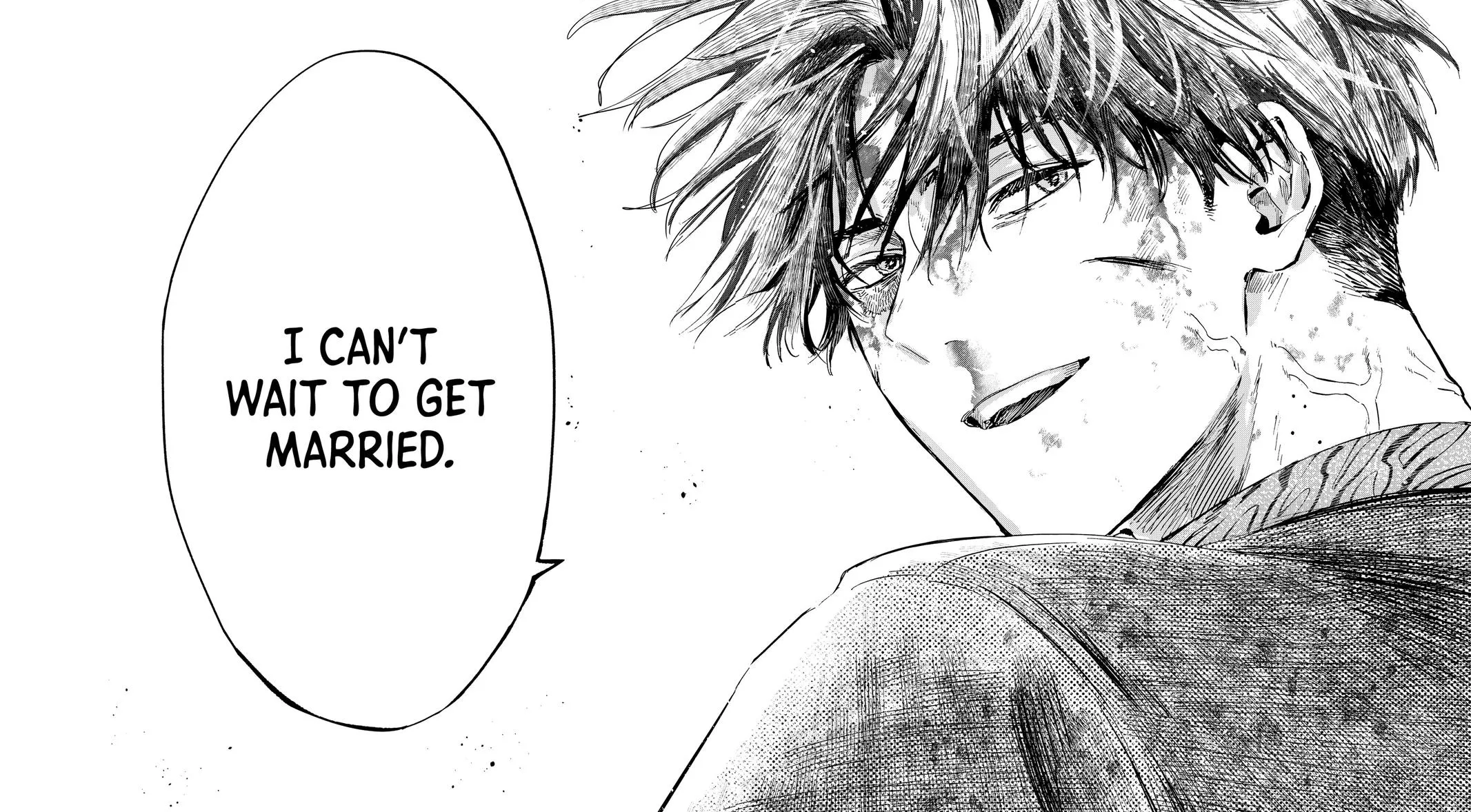
This pivot transforms the series from one that sees a relationship as an end in itself to one that sees a successful relationship as downstream of self-actualization. Getting into a relationship will not fix his problems. Instead, the emphasis is on fixing his own problems so he can bring the best version of himself into the relationship. Often, series in the “harem” romance genre treat the main character deciding on which love interest to pursue as the core of the story. Here, the core of the story is about becoming the kind of person that someone else would choose. It's a refreshingly mature way to talk about relationships; especially from a series featuring a hamster assassin (as in an assassin that uses hamsters not an assassin of hamsters. Don’t be ridiculous).
These ideas extends to how the series treats its women. Even though each arc begins with taking a new job where Hikaru meets a woman and ends with them exchanging numbers, it’s exclusively to be friends and get to know each other better. Each woman also has her own goals and motivations apart from Hikaru giving them a sense of agency in the story. Underlying that is a very sincerely communicated admiration for each of the prospective heroines. It’s nice reading a series where choosing to date someone isn’t given the gravity of a black hole. You might date a lot of people. You can even date someone and decide you’re better off as friends. Dating can even be fun! That might seem obvious but it’s something I wish was expressed in the romance genre more often.
As the series has ballooned in popularity, it’s also garnered some amount of discourse. Most of which revolves around Mei Kinosaki’s gender identity. Queer romance media tends to fall into defined genres with overlapping but still separate fanbases. If you are a person who is only interested in Boys Love (BL) stories, then whether or not Mei is a man might be a make or break issue for you. If you believe Mei is actually a cis woman presenting as a dude presenting as a woman, you might object to the very idea that there is anything queer about this series at all and that I am very silly.
This kind of discussion is as expected, albeit disappointing – especially when the text of the series is seemingly resisting these exact kinds of determinations. Trying to draw clear lines in what appears to be a deliberately ambiguous text is reductive in a way that lessens what is otherwise a fairly interesting vehicle for queer reading.
After having so extensively glazed this series, I have a confession to make: It’s not perfect. It’s messy, but messy in an interesting way, like that 7/10 videogame you adore. You know it has flaws and have some ideas for how it could be improved but that’s also part of what makes it fun to talk about. It’s also not finished so who knows where it will ultimately end up. Personally, I’m an advocate of the GeroSaki agenda. What could be a stronger thematic rebuttal to heteronormative patriarchy of the Gero family than marrying someone without a uterus and instead finding other ways of building a legacy for yourself? They’re also just cute together!

Anyway, that’s what I’ve got for this time. Now I can get back to working on that 50k subscriber video for my youtube channel and you can get back to being nice to yourself.